
Reviewed by Dr Helen Farley, Practice Manager Education and Training – Southern Region, Department of Corrections, Ara Poutama Aotearoa
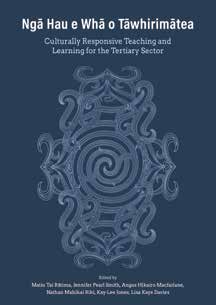
Ngā Hau e Whā o Tāwhirimātea was recently published by Canterbury University Press and edited by Matiu Tai Ratima, Jennifer Pearl Smith, Angus Hikairo Macfarlane, Nathan Mahikai Riki, Kay-Lee Jones, and Lisa Kaye Davies. It is a slender volume at 68 pages but that also makes it accessible for time poor educators both within and outside of the formal education sector. It has been written to facilitate non-Māori educators to support their Māori ākonga. The reality is that any educator following the guidance this volume brings will be doing better by all of their learners. Pedagogically, it is complementary to connectivist and social constructivist strategies that place the ākonga at the centre of learning. It recognises that ākonga bring their own lived experience and identity to learning, and that can be leveraged to ensure more fruitful experiences for both kaiako and ākonga.
The book begins with a foreword by Helen Lomax, Ako Aotearoa, elaborating on its purpose. The Introduction by Professor Angus Hikairo Macfarlane contextualises Māori knowledge in its diversity. It presents a te ao Māori worldview and sets the scene for the rest of the book. It introduces the idea that kaiako and ākonga would benefit from incorporating a te ao Māori worldview, Māori histories, Māori experiences of struggle and Māori lived realities. It poses questions about power, mutual benefit, and monitoring of an embedded te ao
Māori worldview in teaching praxis. We are challenged to shift from commentary to practice, and to put things ‘cultural’ at the centre of all we do.
The introduction identifies a gap in the provision of tools and frameworks which could enable tertiary educators to work in a culturally responsible way. It acknowledges that educators have recognised that they need to be culturally responsible but admits that these same educators don’t know how to put it into practice. It acknowledges that in order to be effective, there needs to be a blending of an evidence-based approach with the more pragmatic methodology of practice. To date, these approaches have been working at odds with each other. There is the call for the sector to ‘broaden and deepen its awareness and respect for knowledge that flows from different, yet potentially complementary, streams’ – in this case, the Māori and the Western knowledge streams (page 6). Indigenous ways of learning have always put the learner at the centre and so too here. All learners benefit from this approach, not just Māori learners. Importantly, this book recognises that adult learners are different, and learners come with their own experiences.
The book opens with an exposition of the Te Tiriti o Waitangi: Treaty of Waitangi as being foundational to the mahi with a call to consider ourselves as Treaty partners before we can consider ourselves as being culturally responsive. It underpins the importance of relationships. It sets out the target audience: this book is for non-Māori and non-Māori organisations to help them engage with their Māori learners and whānau.
There is a ‘How to use this guide’ which makes the book and its message accessible. It makes use of the metaphor of Ngā Hau e Whā o Tāwhirimātea – the four winds of Tāwhirimātea – to represent the four core components of culturally responsive practice: whanaungatanga (relationships), manaakitanga (ethic of care), kotahitanga (unity) and rangatiratanga (student agency and leadership). The model is presented diagrammatically on page 15. Oranga is seen as the central guiding principle, surrounded by the four interconnected components, metaphors for the four winds: Whanaungatanga, Kotahitanga, Rangatiratanga, and Manaakitanga. One blows to the next, drawing and giving to the central idea of oranga. The elements are co-dependent and do not indicate a direction of travel. The model aligns with Macfarlane’s Educultural Wheel (2004).
Oranga: Tihei Mauri Ora! is written by J. P. Smith & T. H. R. Karaka-Clarke. Oranga is central to the model but still incorporates pūmanawatanga of Macfarlane’s Educultural Wheel, referring to the tone, the pulse or the morale established in the educational setting. The relevance and even the necessity of wananga is reinforced, that space for conversation and discussion. Oranga embodies three core principles – relevance, balance of power and scaffolding and these are unpacked in this section. The importance of ako is underscored, and the reciprocity of learners. Power dynamics are acknowledged.
Though this model is about building a te ao Māori worldview within the educational context, and embedding cultural responsiveness, its principles will work for all learners. It represents a model that puts the learner at the centre, contextualises learning and resources, and promotes discourse. This is the embodiment of good education in any culture. No learner will be left behind. It exemplifies good teaching and learning, and rightfully discounts the ‘sage on the stage’ approach that characterises too much of what passes as education in the tertiary sector.
The book explains the meanings and implications of unfamiliar te reo Māori words in a way that is familiar. There are no scary new concepts. These are ideas that we are familiar with as good educators, albeit they may be cast in a slightly different light. In each section, there is a list of additional readings. I really like that all of the knowledge is not crammed into this small guide. It makes it accessible and not overwhelming. There are very easy examples of how to adopt the concepts in everyday teaching and learning so that it doesn’t feel overwhelming. There are places for reflection, empowering educators to personalise the booklet and to make it even more useful going into the future.
Engaging with Hapori Māori by P. Smith & L. K. Davies provides a guide around respectfully reaching out to Māori in the local area. It can also include Māori organisations such as research institutes. The Exemplars of Practice are really useful snapshots of what the incorporation of the model might mean and how that looks. Each case study is written by the educator. The case studies are drawn from a range of contexts.
This small book concludes with Teachable Moments in Tertiary Settings – Ngā Hau e Whā o Tāwhirimātea and Citizenship written by Angus Macfarlane. This is followed by Citizenship Table: An Accompaniment to Teachable Moments in Tertiary Settings – Ngā Hau e Whā o Tāwhirimātea and Citizenship. This is a fitting end to the book which crams so much value into its pages.
Ngā Hau e Whā o Tāwhirimātea is whatever it needs to be. It can be a quick guide to being more responsive to Māori ākonga. You can read what’s there and launch straight in. If you want to take a deeper dive, you can do that too by following up with the additional readings and planning and recording your strategies. What is most pleasing is its accessibility to educators at all levels and in all parts of the tertiary teaching sector. It heralds a way forward that is both achievable and effective.
Ngā Hau e Whā o Tāwhirimātea is available.
Digital edition freely available from UC Research Repository. Print copy forthcoming.